Rachael's Note: March 21st is World Down Syndrome Day (named for Trisomy 21, the condition which causes Down Syndrome).
The diagnosis of Down syndrome often strikes fear and dread in an expectant mother's and father's heart. The Down syndrome diagnosis often brings forth images of mentally handicapped individuals unable to take care for themselves and partake in life in any real way, and the need to care for their child for the rest of their life. Also, many people still view Down Syndrome as "terminal illness" like cancer or heart disease, and the individuals with this condition "defective" or "broken." These and other misconceptions about Down syndrome are often based on worse-case scenarios, misperceptions, sterotypes, and ignorance, and further perpetuate these fears. I have been working in direct care for 7 years and have met and worked with individuals with a variety of developmental disabilities. Today, I will be sharing information, based on my own knowledge/experience as well as from professional/parent resources, to debunk many of the misperceptions and stereotypes about Down Syndrome.
Down Syndrome it is a developmental disability. Down syndrome is a genetic condition that causes delays in physical and intellectual development. While there is no cure for Down syndrome, there are many treatments available for the problems associated with Down syndrome. Approximately 40% of the children have congenital heart defects. Some of the heart conditions require surgery immediately after birth/in early childhood, while others only require careful monitoring. Children with Down syndrome have a higher incidence of infection, respiratory, vision and hearing problems as well as thyroid and other medical conditions. However, with appropriate medical care most children and adults with Down syndrome can lead healthy lives. The average life expectancy of individuals with Down syndrome is 55 years, with many living into their sixties and seventies. Unfortunately, for individuals with Down Syndrome, there is a higher chance of developing dementia and Alzheimer's, however this doesn't mean every individual will develop it.
Also, most people with Down syndrome have only mild to moderate mental retardation. More important than IQ scores is the fact that all individuals with Down syndrome are capable of learning. Most children with Down syndrome in the United States are “mainstreamed” into regular schools. They attend regular classes for some subjects and attend special classes for other subjects and continue to earn a certificate of completion or graduate from high school. A large percentage of adults with Down syndrome live semi-independently in supported living homes and assisted living facilities. Adults with Down syndrome often hold jobs and have romantic relationships. Some high school graduates with Down syndrome participate in post-secondary education. Many adults with Down syndrome are capable of working in the community, but some require a more structured environment, such as a supervised workshop.
It's important to remember that individuals with Down Syndrome are people too. They enjoy various hobbies and activities and have individual likes and dislikes like you and I. Also, people with Down syndrome experience a full range of emotions such as sadness, anger and happiness & they respond to positive expressions of friendship and they are hurt and upset by inconsiderate behavior, just like everyone else.
Disability rights organizations, care providers, and individuals and their families are seeking to educate the public and bring about awareness about Down Syndrome so that better treatments can be found, to lend to more education and understanding of the condition, and bring about awareness.
For more information on Down Syndrome and to listen to families and individuals with Down Syndrome share their insight and experiences, please visit:
Room for More: World Down Syndrome Day
CDAC
Offers scientific research, information, education, and suuport to parents and families of children with Down Syndrome as well as awareness and education for the medical professionals and the general public. Written by parents of a child with Down Syndrome.
National Down Syndrome Society
Offers advocacy, outreach, education, and support and resources for families, parents, and medical professionals. Helpline: 1-800-221-4602
SOFT
Support Organization for Families of Trisomy, a nonprofit volunteer organization offering support for parents who have had or are expecting a child with a chromosome disorder and education to families and professionals interested in the care of these children.
Recommended Down Syndrome Sites on the Internet
Compiled by Len Leshin, M.D.
Hidden Treasures: The Trisomy 21 Journey
Parents from all around the world share their stories.
Video: Dreams
Dreams features children and adults who have Down syndrome talking about their dreams and what they're proud of in their lives. This fun and inspirational video made by Scott and Julia Elliott celebrates the work of the National Down Syndrome Society and the larger Down syndrome community.

My Life in Reflection
Showing posts with label Poor Prenatal Diagnosis. Show all posts
Showing posts with label Poor Prenatal Diagnosis. Show all posts
Friday, March 21, 2014


Friday, June 21, 2013
Ignorance and Stigma is Still Well and Alive, Part Duex
Fellow Blogger, MoronicProchoice Quotes brings to our attention this little gem from a pro-choicer on Twitter...

Ugh, this is not the first time (nor will it be the last) I've heard such an ignorant & bigoted thing said about the developmentally disabled & it really angered me. I replied...
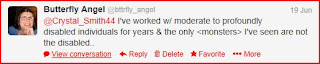

Butterfly Angel @bttrfly_angel: "@Crystal_Smith44 I've worked w/ moderate to profoundly disabled individuals for years & the only I've seen are not the disabled individuals I work with, but ignorant & prejudiced people like you"

Not but within an hour after I responded, she blocked me and the tweet was removed within a couple of days as well. Not surprised, some prejudiced people don't like to be called out on their bigotry, but I disgress. Her insult towards the developmentally disabled aside, I'd like to address her claim about forcing women to carry pregnancies with a poor prenatal diagnosis. One point I'd like to make is about the assumption and pressure women face from their doctors, support person, and even family to terminate the pregnancy (have an abortion) when facing a poor prenatal diagnosis. This is discussed in a couple of articles written from the viewpoint of parents of a child(ren) with disability who experienced it first hand as well as medical journal articles:
DS Screening: A Few Cautionary Thoughts
Down Syndrome Support Groups Rise to Counter Physicians’ Poor Diagnostic Practices
Prenatal diagnosis of hypoplastic left heart syndrome: impact of counseling patterns on parental perceptions and decisions regarding termination of pregnancy
Is there pressure from society to terminate pregnancy in case of a fetal anomaly?
For the reason I'd like to move the focus away from the abortion debate and back to the pregnant woman and to the child(ren) she's carrying and ask: is enough being done to inform the woman and her partner about the ramifications of prenatal testing and to provide them with support and options other than termination? For that reason, I'd like to make a call for more compassion towards women facing a poor prenatal diagnosis, and let's give them a support system, medical resources, and options. Also, it's important to continue to educate and bring awareness to the public.

Crystal
@Crystal_Smith44: "Grandstand much @RepHartzler ? Forcing women to bear children< monsters> w/ genetic defects is barbaric, shame on you. #Fem2"
Ugh, this is not the first time (nor will it be the last) I've heard such an ignorant & bigoted thing said about the developmentally disabled & it really angered me. I replied...


Butterfly Angel @bttrfly_angel: "@Crystal_Smith44 I've worked w/ moderate to profoundly disabled individuals for years & the only I've seen are not the disabled individuals I work with, but ignorant & prejudiced people like you"

Not but within an hour after I responded, she blocked me and the tweet was removed within a couple of days as well. Not surprised, some prejudiced people don't like to be called out on their bigotry, but I disgress. Her insult towards the developmentally disabled aside, I'd like to address her claim about forcing women to carry pregnancies with a poor prenatal diagnosis. One point I'd like to make is about the assumption and pressure women face from their doctors, support person, and even family to terminate the pregnancy (have an abortion) when facing a poor prenatal diagnosis. This is discussed in a couple of articles written from the viewpoint of parents of a child(ren) with disability who experienced it first hand as well as medical journal articles:
DS Screening: A Few Cautionary Thoughts
Down Syndrome Support Groups Rise to Counter Physicians’ Poor Diagnostic Practices
Prenatal diagnosis of hypoplastic left heart syndrome: impact of counseling patterns on parental perceptions and decisions regarding termination of pregnancy
Is there pressure from society to terminate pregnancy in case of a fetal anomaly?
For the reason I'd like to move the focus away from the abortion debate and back to the pregnant woman and to the child(ren) she's carrying and ask: is enough being done to inform the woman and her partner about the ramifications of prenatal testing and to provide them with support and options other than termination? For that reason, I'd like to make a call for more compassion towards women facing a poor prenatal diagnosis, and let's give them a support system, medical resources, and options. Also, it's important to continue to educate and bring awareness to the public.
Thursday, May 27, 2010
One Year Anniversary of Late-term Abortion Provider George Tiller Death
Monday, May 31 - Memorial Day, this year - will mark the 1 year anniversary of abortion provider George Tiller's murder.

Pro-choice activists have been paying tributes and are planning memorials. Democrat Senate Majority Leader Harry Reid has read or will read a Tiller tribute statement on the Senate floor today.
For a donation of $75 the TX Equal Access Fund "will deliver a handmade card, flowers, and a basket of goodies" to your favorite abortion provider on May 31. Why not instead deliver flowers to the women and families of women who were injured or killed during supposed "safe and legal" late-term abortions at George Tiller's clinic. Where's their concern for these women and their families? Does their concern not extend beyond the woman's abortion?
The George Tiller Abortion Fund has been established to subsidize late-term abortions. However, I think it's important to keep in mind that often in the case of a theraputic late-term abortion for health reasons or poor prenatal diagnosis, the woman has often been has been given a worst-case scenario and feels that she has run out of options and she may have been told that an abortion is the best option by her doctor despite carrying a wanted pregnancy. Rather than abandoning these women to despair and hopelessness and feeling they have no choice but to have an abortion, instead let's give them a support system, medical resources, and options. Instead of supporting the George Tiller Abortion Fund, instead consider donating to organizations such as Be Not Afraid, Prenatal Partners for Life, or your local prenatal hospice, establish a community outreach to parents who have received a poor or difficult prenatal diagnosis, create a database of community resources for those with special needs children, purchase and distribute Ashli McCall's book "Beyond Morning Sickness: Battling Hyperemesis Gravidarum" to families and doctor's offices, sew memory blankets or create a comfort basket for a family facing neonatal death or infant death, or offer to help a family by bringing meals over or assisting with errands. To this end, we can help support and comfort families through their challenges, grief, and sorrows and healing journeys.
Picture credit: Jill Stanek
Wednesday, April 1, 2009
A Story of Hope....
The Story of Faith Hope
A diagnosis of anencephaly has not stopped this young single mom from embracing every day, every moment, of her child's life. A chance at life and joy, even if brief, which would of been taken from this mother and child, had she had an abortion. And a wonderful story of hope and encouragement for other mothers experiencing this devastating diagnosis.
H/T Christina at Real Choice
If you're facing a poor prenatal diagnosis, please check out Be Not Afraid where you'll find other mothers stories and hope.
Thursday, December 18, 2008
A Book Worth Having: Beyond Morning Sickness
The book is entitled, "Beyond Morning Sickness: Battling Hyperemsis Gravidarum" and is written by Ashli McCall. During Ashli's four pregnancies, she experienced Hyperemsis Gravidarum, a rare disorder characterized by severe and persistent nausea and vomiting during pregnancy, which lead to hospitalizations for dehydration, vitamin and mineral deficiencies, and excess weight loss as well as just plain misery. During Ashli's first pregnancy, her physicians gave her little information or hope on the treatment options available for HG; with some physicians outright insensitive to the condition, while others were apologetic, unable to offer her relief. As a disease it was under-studied, poorly understood, and fraught with the myths of years of misinformation and misunderstanding from the medical profession. Feeling abondoned, very sick, and her health in jepordy, at four months, she gave in to the advice of her doctor and relatives, ending the very much wanted pregnancy. Here is her story, from an interview on CNN:
The lack of information and support for women with HG in the medical community has had an impact on Ashli and and now she seeks to educate, inform, and support other women who find themselves facing this debilitating illness. More on Ashli's book as well as a support forum for mothers facing HG can be found at her website Beyond Morning Sickness.com.
The lack of information and support for women with HG in the medical community has had an impact on Ashli and and now she seeks to educate, inform, and support other women who find themselves facing this debilitating illness. More on Ashli's book as well as a support forum for mothers facing HG can be found at her website Beyond Morning Sickness.com.
Friday, September 26, 2008
Ignorance and Stigma is Still Well and Alive, Redux
Back in this May entry, I shared my own experience with an unenlightened individual, which made it clear that many with developmental disabilities still face the challange of ignorance and bigotry among the general public. However, unfortuantly his view and atitude towards the developmental disabled is not abnormal. Below, I've compiled various articles, quotes, and stories sharing the additional challenges individuals with these disabilities and their family members face, from poor, misleading, and discouraging counsel from their doctors to ignorance and rude comments, and even outright hatred from family, friends, and the general public.
A collection of comments from the general public regarding Sarah Palin's son Trig and other individuals living with Down Syndrome:
"This baby should have never been allowed to live a life of suffering. Gov. Palin should have aborted the pregnancy and saved this person a life of difficulty."
"Howard [Stern] thought that Sarah Palin should have not delivered the child that was going to be born with a reduced resources, and he went on and on about it." (NB: Stern hates Bristol's baby, too: “Any self respecting mother would have taken her daughter to an abortion clinic and had that blood clot removed”)
"Sarah Palin’s judgment is despicalble. She knowingly whelped a Mongoloid child earlier this year, probably to pander to the Right to Life Nutbags."
"No one has the right to bring a defective child into the world it is a form of self-love and shows no love for the child." (Scroll down)
"She should have aborted the Downs child…. no, giving him life was not the best thing." (Comment #387)
"I disagree with condemning the baby to a second-class life full of discomfort. I think it's more cruel to bring a baby into this world that you know will suffer and that cannot be cured. .... The issue is KNOWING that the baby will have Down syndrome and still being callous enough to bring it into the world." (Answer 2)
"She shouldn't have gotten pregnant. It was selfishness. And she should have aborted the fetus."
"It's obvious this comment came from some ignorant poor THING with self-esteem issues and the mental capacity of Palin's poor THING of a son that she should have aborted as soon as she knew he would never be a productive member of society!" (#33)
"We don't even have the funds to properly education normal children. Now we want to add more funding for Special Needs children whom, in many cases, have a birth defect their parents knowingly acknowledged prior to their birth, yet chose to have that baby anyway? I say let the parents of these children fund their education. Don't force your choice on the rest of us."
"Listen. This is a defective unit. Humanity is much better off without it. It would be a drain on the system, and who the fuck really cares anyway? It would just be laughed at. It's better off dead."
"I thought an unaborted mongoloid baby was the symbol of the Republican Party."
"I’ll tell you what is TRULY reprehensible...(2.) Bringing a retarded child into the world knowing that it will never be able to take care of itself or have a normal life just to validate your nutty God-botherer credentials to teh other nutty God-botherers."
"Tests can be done to see whether you’re carrying an embryo that is affected, and you can abort said embryo and become pregnant with a normal child, should you so choose (abnormal, in this case, is not meant to imply any kind of judgement, but rather describes an aberration from the norm - as in the chromosomes did not seperate properly)."
H/T to Christina at Real Choice
What Can I Do?
These are some suggestions for the general public for understanding and respecting the differences and similiarities in those with disabilities.
- I encourage those who aren't familiar with developmental disabilities to learn, learn, learn! This can be via books at your local library, advocacy organizations, publications from websites, etc.
- Listen to the stories of parents who'd received an adverse prental diagnosis: Be Not Afraid: Stories
- When you see someone with a disability out and about, please don't gawk, stare, or just plain give dirty looks. We're trying to normalize life for these individuals, not make it more difficult!
- Although someoneone with a disabilitiy may appear different from the outside; remember, we're all alike in some way or another and they are human beings just like you and me, with feelings and emotions, favorite foods, music styles, sports, hobbies, and activities they enjoy, etc.
- Remember, many individuals are handiCAPPABLE, meaning they strive to be independent and many are capable in different areas. With this said, don't offer help to someone unless they ask you or they clearly imply they need your help (i.e. feeding themselves, reaching on shelves, picking up an item, opening doors, etc).
Down Syndrome Families Brought Into Sharp Focus"Respecting choice" and "Nobody is for abortion"
"Many parents also talk about how the phone never rings with invitations for a play date for their children or an offer to help carpool. Sometimes, they find themselves answering people who suggest that their child should never have been born.
That happened to Tia Marsili, 49, of Vienna while driving from her hometown in western Pennsylvania to Virginia Beach with her sister. The trip lasted six hours and was not without some fussing from Marsili's daughters, Sheridan and Skye. Both girls have Down syndrome. Sheridan's condition had come as a surprise after birth, but Marsili knew from prenatal testing that Skye would have Down syndrome.
"My sister looked at me and said, 'Why didn't you abort her?' " Marsili recalled. "I said, 'What? Because we love her, and she's my baby, and we love her!' 'But you knew,' my sister said. . . . It was pretty shocking. Even people that close to me."
http://www.washingtonpost.com/wp-dyn/content/article/2008/09/13/AR2008091301034.html
Thursday, October 16, 2008
By Penny Starr, Senior Staff Writer
(CNSNews.com) – Women diagnosed as carrying a Down syndrome baby often receive poor, misleading, and discouraging counsel from their doctors – the most frequent comments being an apology offered with the option of aborting their baby.
That inadequate and incomplete counsel has prompted Down syndrome support groups to spring to life across the nation.
“It’s so misleading,” Mia Willson, whose daughter Mylie, 7 months, has Down syndrome, told CNSNews.com. “The truth is, some Down syndrome children are born with medical conditions, but with the advances in technology, most can be easily treated.”
Children with Down syndrome, caused by an extra chromosome, have varying degrees of mental retardation and often have heart problems. Since the advent of pre-natal testing in the mid-1970s, the number of babies diagnosed with Down syndrome and then aborted is nine out of ten. Prior to that time, nearly all such babies were born.
The Willson family, from left, Mia, Mylie, Tyson and Tyler.Dr. Brian Skotko, a pediatrician at Boston Children’s Hospital, conducted a survey of more than 1,000 women who had a Down syndrome child in 2005, 12.5 percent of which were mothers who had received a pre-natal diagnosis.
Those 141 women reported “incomplete, inaccurate or offensive” information about Down syndrome at the time of diagnosis. They also said they weren’t connected to resources that could help them understand their child’s condition.
“There is one thing that the mothers spoke very clearly on in my research -- was the connection with other parents made a big difference,” Skotko, who has a sister with Down syndrome and serves on several boards of Down syndrome advocacy groups, told CNSNews.com.
Skotko’s own research and a 2006 survey of 1,105 junior fellows and fellows for the American College of Obstetrics and Gynecologists show that doctors are not trained to share positive information about children with Down syndrome at the time of diagnosis. In the ACOG study, 45 percent of respondents rated their residency training regarding pre-natal diagnosis as “barely adequate” or “non-existence.”
“Doctors aren’t necessarily trained or know the answer to, for example, what is it like to raise a child with Down syndrome? Will my child go to prom one day? What affect will this have on my other children and my marriage?” Shotko said.
As reported by CNSNews.com in an earlier story, a study of 499 primary care physicians revealed that only 4 percent encouraged their patients to continue their pregnancy.
Willson recalls when her daughter was in the intensive care unit for a heart condition diagnosed shortly after birth. The nurse on duty had a son with Down syndrome.
“She said, ‘Oh, I’m so excited for you. This child is going to melt your heart,’” Willson recalled. “I couldn’t understand why she was so positive when the doctors had been so solemn and even negative. They said, ‘I’m sorry, I’m so sorry.’ There’s nothing to be sorry about.”
These kind of negative experiences have led Wilson and other parents across the country to launch grassroots groups that offer both pre- and post-natal support, and connect parents with the kind of support and resources they need to raise a special needs child.
In Willson’s case, she agreed to pre-natal screenings, which did not show an increased risk of having a baby with Down syndrome. So Willson did not opt for diagnostic tests.
After Mylie’s birth, Willson and her husband, Tyler, learned their daughter had the genetic condition and some medical complications. Post-natal tests determined she had two holes in her heart and a thyroid condition. She was also extremely sensitive to gluten. But Willson said the holes closed on their own and medication and the proper diet have helped her daughter thrive.
Willson, 32, helped start The Real Face of Down Syndrome with JaimieWeitzman, whom she met through programs in place at the California hospital where their children were born that connects parents with other parents who have children with the condition.
“I called her and it was so wonderful to talk to someone my age that had a new daughter with Down syndrome,” Willson said.
Since connecting through a support group for parents of Down syndrome, the Willson and Weitzman kids have become friends, from left, Mylie and Tyson Willson and Julie, Sarah and Hannah Weitzman.“It’s amazing all the negative things people hear,” Weitzman, whose Down syndrome daughter Hannah just turned one, told CNSNews.com. “We’re not experiencing those negative things. Yes, this family has been changed forever, but I mean forever in a positive way.”
Willson and Weitzman also were inspired to start their effort after hearing statistics that show as many as nine out of 10 women who are diagnosed pre-natally with carrying a child with Down Syndrome choose to have an abortion.
“We were just devastated when we found out how high the percentage was,” Willson said. “We didn’t think it is fair that these children don’t have a chance just because they have an extra chromosome. We wanted to get the message out about these children.”
“These children have souls,” Willson said. “They are like any other child.”
Willson and Weitzman, 31, have created a brochure with family photographs and the contact information for resources to help parents who have received a Down syndrome diagnosis or have a newborn with the condition. They are putting them, with the help of their pediatrician, in hospitals, doctors’ offices and other places where “children of child-bearing age” might pick one up.
Lucy Talbot is the president of Families Exploring Down Syndrome, a non-profit organization founded in 1989 “by a group of parents who felt the need to share a common bond with families in the area who were experiencing the same feelings, heartaches, and joys.”
The organization has adopted and implemented the National Down Syndrome Society’s Changing Lives program, which puts parent volunteers and their children with Down syndrome into medical settings to demonstrate to health professionals the true nature of these children and the importance of giving pre- or post-natally diagnosed parents complete and accurate information.
Today, the Michigan-based organization has more than 200 active family members, including Talbot, who adopted her daughter Megan, who has Down syndrome, after a doctor told Megan’s birth parents that they didn’t have to raise the child.
“Instead of giving (the parents) hope or connecting them with someone who knows about Down syndrome,” Talbot said, the doctor said to give the child away. Megan ended up with Talbot as a foster child and was eventually adopted.
Talbot’s organization also supports new parents of Down syndrome children by providing them with “new parent packages,” which includes resources, information and lots of photos.
“They need to see these children,” says Talbot, whose daughter Megan, now 19, is graduating from high school, has a part-time job at Macy’s and went to the prom with a good friend.
Willson and Weitzman agree that including photographs on their brochure was essential.
“We want people to see that we are still a family, we are happy,” Willson said.
“We are a joyful family,” Weitzman said.
That’s also true for Kadi Coe, who knew before her daughter Ayla, now 10 months, was born that she had Down syndrome. Coe, 30, was screened for the genetic disorder, which showed she was at high risk for having a child with Down syndrome. Diagnostic tests confirmed that fact.
“I was devastated,” Coe told CNSNews.com. “It was something that I’d never even thought of. You don’t think something like this will happen to you. I thought my world had ended.”
Coe admits, even though she and her husband consider themselves pro-life, that they thought about abortion.
“I heavily thought about terminating,” Coe said. “It was an agonizing decision, but I thought I would grieve for her for the rest of my life.”
Coe was also helped by Amanda Clarke, who also was pre-natally diagnosed with carrying a child with Down syndrome and had joined Families Exploring Down Syndrome.
“It was amazing,” Coe said of talking with Amanda. “I thought, ‘Oh my gosh, you understand how I’m feeling.’ (The support group) was the only thing that kept me going.”
And even if Coe describes the day Ayla was born as “the scariest thing in my life,” that fear quickly changed to joy when she saw her daughter for the first time.
“My worries washed away,” Coe said. “I can’t imagine my life without her.”
Coe, who has an older daughter, added that she is grateful on a daily basis that she didn’t choose abortion.
“Not a day goes by that I’m glad I didn’t do that to her,” Coe said. “I still cry thinking that I almost did that.”
For Weitzman, having a child with Down syndrome proved almost prophetic.
As a sixth-grader, Weitzman said she was drawn to volunteer in the classroom where children with Down syndrome were taught at her school. Her mother also worked as a volunteer with Down syndrome children.
“I always had this sense that I knew I would have a child with Down syndrome,” Weitzman, who has two other daughters, said. “I feel like the Lord was preparing me.”
She said she declined to have any of the pre-natal tests offered by her doctor during both pregnancies.
And now that Hannah has celebrated her first birthday, Weitzman says not only has her birth brought the family closer together, but she said her older girls will also be blessed by their special sibling.
“I think they will learn to love in a broader way,” Weitzman said. “I think they will grow up to be better people.”
A collection of comments from the general public regarding Sarah Palin's son Trig and other individuals living with Down Syndrome:
"This baby should have never been allowed to live a life of suffering. Gov. Palin should have aborted the pregnancy and saved this person a life of difficulty."
"Howard [Stern] thought that Sarah Palin should have not delivered the child that was going to be born with a reduced resources, and he went on and on about it." (NB: Stern hates Bristol's baby, too: “Any self respecting mother would have taken her daughter to an abortion clinic and had that blood clot removed”)
"Sarah Palin’s judgment is despicalble. She knowingly whelped a Mongoloid child earlier this year, probably to pander to the Right to Life Nutbags."
"No one has the right to bring a defective child into the world it is a form of self-love and shows no love for the child." (Scroll down)
"She should have aborted the Downs child…. no, giving him life was not the best thing." (Comment #387)
"I disagree with condemning the baby to a second-class life full of discomfort. I think it's more cruel to bring a baby into this world that you know will suffer and that cannot be cured. .... The issue is KNOWING that the baby will have Down syndrome and still being callous enough to bring it into the world." (Answer 2)
"She shouldn't have gotten pregnant. It was selfishness. And she should have aborted the fetus."
"It's obvious this comment came from some ignorant poor THING with self-esteem issues and the mental capacity of Palin's poor THING of a son that she should have aborted as soon as she knew he would never be a productive member of society!" (#33)
"We don't even have the funds to properly education normal children. Now we want to add more funding for Special Needs children whom, in many cases, have a birth defect their parents knowingly acknowledged prior to their birth, yet chose to have that baby anyway? I say let the parents of these children fund their education. Don't force your choice on the rest of us."
"Listen. This is a defective unit. Humanity is much better off without it. It would be a drain on the system, and who the fuck really cares anyway? It would just be laughed at. It's better off dead."
"I thought an unaborted mongoloid baby was the symbol of the Republican Party."
"I’ll tell you what is TRULY reprehensible...(2.) Bringing a retarded child into the world knowing that it will never be able to take care of itself or have a normal life just to validate your nutty God-botherer credentials to teh other nutty God-botherers."
"Tests can be done to see whether you’re carrying an embryo that is affected, and you can abort said embryo and become pregnant with a normal child, should you so choose (abnormal, in this case, is not meant to imply any kind of judgement, but rather describes an aberration from the norm - as in the chromosomes did not seperate properly)."
H/T to Christina at Real Choice
What Can I Do?
These are some suggestions for the general public for understanding and respecting the differences and similiarities in those with disabilities.
- I encourage those who aren't familiar with developmental disabilities to learn, learn, learn! This can be via books at your local library, advocacy organizations, publications from websites, etc.
- Listen to the stories of parents who'd received an adverse prental diagnosis: Be Not Afraid: Stories
- When you see someone with a disability out and about, please don't gawk, stare, or just plain give dirty looks. We're trying to normalize life for these individuals, not make it more difficult!
- Although someoneone with a disabilitiy may appear different from the outside; remember, we're all alike in some way or another and they are human beings just like you and me, with feelings and emotions, favorite foods, music styles, sports, hobbies, and activities they enjoy, etc.
- Remember, many individuals are handiCAPPABLE, meaning they strive to be independent and many are capable in different areas. With this said, don't offer help to someone unless they ask you or they clearly imply they need your help (i.e. feeding themselves, reaching on shelves, picking up an item, opening doors, etc).
Resources:
Families Exploring Down Syndrome, http://www.familiesexploringdownsyndrome.org/, (586) 997-7607
Autism Society, http://www.autism-society.org/, 1.800.3AUTISM (1.800.328.8476)
Autism Society, http://www.autism-society.org/, 1.800.3AUTISM (1.800.328.8476)
Friday, December 23, 2005
Adverse Prenatal Diagnosis & Maternal Health Conditions Information and Support
It's not an easy time for you. You suspect that something's wrong with your pregnancy or baby, and maybe you've had a positive test, which only confirm your fears. Or perhaps you're here seeking out information and/or help for a friend or relative. Here you'll find a wealth of resources and information to educate, empower, and support you. Take a deep breath, try to relax, and then learn everything you can about your situation.
About Prenatal Testing and General Information:
American Pregnancy Association: Birth Defects
Education on diagnosis, prevention, causes, and treatment to help families manage birth defects.
http://americanpregnancy.org/birthdefects/index.htm
American Pregnancy Association: Prenatal Testing
http://www.americanpregnancy.org/prenataltesting/
StorkNet: Pregnancy Complications
http://www.storknet.com/complications/index.html
Association of Birth Defect Research for Children, Inc.
The Association of Birth Defect Children (ABDC) is a non-profit organization, started by parents in 1982, which provides information and support to parents of children with birth defects.
930 Woodcock Road
Suite 225
Orlando, FL 32803
Tel: 407-895-0802
800-313-ABDC (2232)
Fax: 407-895-0824
http://www.birthdefects.org/
Specific Disabilitities/Illness Information:
Absence of Corpus Callosum:
Agenesis of the Corpus Callosum means a complete or partial absence of the bridge between the left and right sides of the brain. In and of itself, the corpus callosum is not necessary for life or health, but conditions associated with ACC can lead to serious medical problems including abnormalities of cerebrospinal fluid or mental retardation. Some individuals will have mild symptoms while others may be severely restricted in their daily life. Treatment is supportive and corrective and can help these individuals reach their full developmental potential, with early educational intervention and special education services in the school, in-home education and support services for the family, behavioral therapy, medication, physical therapy, and occupational therapy as needed, and correctional and supportive treatment of physical abnormalities.
National Organization of Disorders of the Corpus Callosum
http://www.nodcc.org/
Amniotic Band Syndrome:
Amniotic Band Syndrome refers to abnormalities caused by fibrous strands that can entangle or confine developing parts of the fetus. These strands are believed to arise from membranes that form outside the placenta. Symptoms associated with Amniotic Band Syndrome include limb or skull abnormalities, cleft lip/palate, scoliosis, and other, more complex abnormalities. The treatment is supportive with physical therapy, occupational therapy, orthopedic instruments, and when necessary, surgery. Most individuals will have a normal lifespan.
Amniotic Band Syndrome
http://www.amnioticbandsyndrome.com/
Acardiac Twinning (TRAP):
Anencephaly, Encephalocele, Hydrocephaly, Spina Bifida, and Related Conditions:
Anencephaly is a type of neural tube defect (NTD). Babies with anencephaly have major portions of the brain, the skull, and the scalp missing. They usually have normal bodies and functioning organs. The child may be born stillborn or the presence of a brain stem may keep the organs operating for a period of time, and the child may live anywhere from days to weeks, however the condition is ultimately terminal.
Encephalocele is a birth defect that results in a hole in the skull through which brain tissue protrudes. Other abnormalities often occur with encephaloceles. These may include hydrocephalus (excessive fluid in the brain), mirocephaly (abnormally small head), paralysis of the arms and legs, seizures, developmental delays, mental and growth retardation, and/or vision problems. Treatment is supportive and corrective and can help these individuals reach their full developmental potential, with early educational intervention and special education services in the school, in-home education and support services for the family, behavioral therapy, medication, physical therapy, and occupational therapy as needed, and correctional and supportive treatment of physical abnormalities.
Hydrocephalus is an abnormal build up of cerebrospinal fluid (CSF) in the brain that causes ventricles to enlarge and the pressure inside the head to increase. Hydrocephalus occurs when there is an imbalance in the amount of CSF being produced and absorbed. Hydrocephalus is treated by surgically placing a shunt in the brain, which drains into the abdomen, where the excess fluid is then reasorbed. Most individuals with this condition will have a normal lifespan and lead normal lives.
Anencephaly Blessings from Above
A pro-life anencephaly support group. A christian forum to encourage and support families whose baby has been newly diagnosed; who are currently carrying a baby to term or have carried a baby to term; who are considering, in the midst of, or having experienced a subsequent pregnancy; and any others who have been touched by anencephaly - parents, relatives, professionals, or friends who wish to share their stories and support. This forum respects the sanctity of life from conception to natural death.
http://clubs.yahoo.com/clubs/anencephalyblessingsfromabove
Anencephaly Support Foundation
Non-profit support organization with information, personal stories, and resources for families, parents, and medical professionals.
asf@asfhelp.com
Tel: 888-206-7526
http://www.asfhelp.com/
Anencephaly-Info
A comprehensive website of of parents stories, medical information, support, and resources
http://www.anencephalie-info.org/index.php
Faith Hope
A diagnosis of anencephaly has not stopped this young single mom from embracing every day, every moment, of her child's life, who lived beyond birth with this condition. A wonderful story of hope and encouragement for other mothers experiencing this devastating diagnosis.
http://babyfaithhope.blogspot.com/
Hydrocephalus Organization
Non-profit support and advocacy group information on resources and education for families and individuals.
870 Market Street, Suite 705
San Francisco, CA 94102
Tel: (415) 732-7040 or toll-free (888) 598-3789
info@hydroassoc.org
http://www.hydroassoc.org/
Spina Bifida Association
Voluntary health agency dedicated to support, education, advocacy, research and service
4590 MacArthur Boulevard, NW
Washington , DC 20007
Phone: 202-944-3285
Toll Free: 800-621-3141
Fax: 202-944-3295
http://www.spinabifidaassociation.org/
Anophtalmia/Microphtalmia (absent or small eyes):
Anophtalmia means that one or both eyes didn’t form during the early stages of pregnancy. Congenital anophtalmia may occur alone or with other malformations. Microphthalmia means that the eye/s started to form during pregnancy but stopped, leaving the baby with eyes that are smaller than normal. Treatment is supportive and corrective and can help these individuals reach their full developmental potential, with correctional and supportive treatment of physical abnormalities.
International Children's Anophthalmia Network
http://www.anophthalmia.org/
Micro and Anophthalmic Children's Society
http://www.macs.org.uk/
Micropthalmia Group
http://groups.yahoo.com/group/Microphthalmia
Anorectal Malformations (imperforate anus, rectal atresia):
Anorectal malformations are a group of birth defects than involve the external opening of the anus preventing the normal passage of stool. The anal opening may be smaller than normal size; in an abnormal location or not visible upon examination. Imperforate anus is usually present along with other birth defects—spinal problems, heart problems, tracheoesophageal fistula, esophageal atresia, renal anomalies, and limb anomalies are among the possibilities. Treatment for anorectal malformations includes immediate surgery to open a passage for feces and for the other accompnying conditions treatment consists of supportive treatment with physical therapy, occupational therapy, orthopedic instruments, and when necessary, surgery..
The Pull-Thru Network
http://www.pullthrough.org/
Cincinnati Children's Hospital: Imperforate Anus / Anorectal Malformations
http://www.cincinnatichildrens.org/health/info/abdomen/diagnose/anorectal-malformations-imperforate-anus.htm
Cleft Lip and Cleft Palate:
An oral cleft is a split or separation in the baby’s lip and/or palate. Cleft lip means that the two sides of the upper lip did not grow together properly. Cleft palate is a split or opening in the roof of the mouth. The opening in the lip or palate may be unilateral, only on one side, or bilateral, on both sides. Cleft lip and palate can occur together or individually. Cleft lip and palate is very treatable; however, the kind of treatment depends on the type and severity of the cleft. Possible treatment options include speech therapy, prosthetics (to cover or to close the gap made by the cleft palate), lengthening of the palate, and surgical procedures. A cleft lip or palate can be successfully treated with surgery, especially so if conducted soon after birth or in early childhood, and the scar becomes less visible with age. Speech problems are usually treated by a speech-language pathologist.
American Cleft Palate-Craniofacial Association/Cleft Palate Foundation
1504 East Franklin Street, Suite 102
Chapel Hill, NC 27514-2820
(919) 933-9044
http://www.cleftline.org/
Cleft Lip and Palate Association
First Floor Green Man Tower
332B Goswell Road
London EC1V 7LQ
http://www.clapa.com/
Chromosomal Abnormalities:
Trisomy 13 (Patau Syndrome)
Patau syndrome, also known as trisomy 13 and trisomy D, is a chromosomal abnormality, a syndrome in which a patient has an additional chromosome 13, which means each cell in the body has three copies of chromosome 13 instead of the usual two copies. Medical management of children with Trisomy 13 is planned on a case-by-case basis and depends on the individual circumstances of the patient. Treatment of Patau syndrome focuses on the particular physical problems with which each child is born. Many infants have difficulty surviving the first few days or weeks due to severe neurological problems or complex heart defects. Surgery may be necessary to repair heart defects or cleft lip and cleft palate. Physical, occupational, and speech therapy will help individuals with Patau syndrome reach their full developmental potential.
Trisomy 18 (Edwards Syndrome)
Trisomy 18 (T18) (also known as Trisomy E or Edwards syndrome) is a genetic disorder caused by the presence of all or part of an extra 18th chromosome. Only 50% of liveborn infants live to 2 months, and only 5–10% survive their first year of life. Major causes of death include apnea and heart abnormalities. However, it is impossible to predict the exact prognosis of a child with Edwards syndrome during pregnancy or the neonatal period. The median lifespan is 5–15 days. One percent of children born with this syndrome live to age 10, typically in less severe cases of the mosaic Edwards syndrome.
Trisomy 21 (Down Syndrome)
Down syndrome is “a developmental abnormality characterized by trisomy of human chromosome 21" Most individuals with Down syndrome have mental retardation in the mild (IQ 50–70) to moderate (IQ 35–50) range, with individuals having Mosaic Down syndrome typically 10–30 points higher. Cognitive development in children with Down syndrome is quite variable. It is not currently possible at birth to predict the capabilities of any individual reliably, nor are the number or appearance of physical features predictive of future ability. Due to the nature of prenatal screens, each has a significant chance of a false positive, suggesting a fetus with Down syndrome when, in fact, the fetus does not have this genetic abnormality. Screen positives must be verified before a Down syndrome diagnosis is made. Treatment for individuals with Down Syndrome is supportive and corrective and can help these individuals reach their full developmental potential, with early developmental/educational intervention and special education services in the school, in-home education and support services for the family, behavioral therapy, medication, physical therapy, and occupational therapy as needed, and correctional and supportive treatment of physical abnormalities.
99 Balloons
A video journal created by parents documenting the life of their son Elliot, who was born with Trisomy 18 and lived 99 days.
http://www.youtube.com/watch?v=th6Njr-qkq0
http://www.ninetynineballoons.com/
A Trisomy 18 Journey
Support website with information on Trisomy 18/Trisomy 13, personal stories, and resources for families, parents, and medical professionals.
http://www.geocities.com/wilsfordmindy/
Band of Angels
Offers outreach, education, and support to parents and families of children with Down Syndrome as well as awareness and education for the medical professionals and the general public.
http://www.bandofangels.com/
CDAC
Offers scientific research, information, education, and suuport to parents and families of children with Down Syndrome as well as awareness and education for the medical professionals and the general public. Written by parents of a child with Down Syndrome.
http://www.cdadc.com/ds/
Hidden Treasures: The Trisomy 21 Journey
Parents from all around the world, who would like to share their stories.
http://hiddentreasuresthet21journey.blogspot.com/
International Mosaic Down Syndrome Association
The International Mosaic Down Syndrome Association is designed to assist any family or individual whose life has been affected by mosaic Down syndrome
http://www.imdsa.org/
Living with Trisomy
Support for Trisomy Families
http://www.livingwithtrisomy.org/
Mosaic Down Syndrome
Karlee has mosaic Down Syndrome. Her site also contains a whole page of family stories of other mosaic Down Syndrome children from around the world complete with e-mail links.
http://www.mosaicdownsyndrome.com/index.htm
National Down Syndrome Society
Offers advocacy, outreach, education, and support and resources for families, parents, and medical professionals. Helpline: 1-800-221-4602
http://www.ndss.org/
Pathfinder Village
A place where persons with Down Syndrome can get the support and acceptance they need to live productive lives.
http://www.pathfindervillage.org/
Recommended Down Syndrome Sites on the Internet
Compiled by Len Leshin, M.D.
http://www.ds-health.com/ds_sites.htm
SOFT
Support Organization for Families of Trisomy, a nonprofit volunteer organization offering support for parents who have had or are expecting a child with a chromosome disorder and education to families and professionals interested in the care of these children.
http://www.soft.org/
Three Weddings
A journal created by a mother, documenting the joys and challenges of raising 3 daughters, including daughter "Peanut" who was born with Trisomy 21 (Down Syndrome). Also, under her Blogroll, you can find links to blogs of other parents with infants/children with Down Syndrome.
http://www.my3weddings.com/
Unique - Rare Chromosome Disorder Support Group (UK)
http://www.rarechromo.org/
Video: DOWN SYNDROME!? not MY baby!!
Information and support by a parent for other parents of a child newly diagnosed with Down Syndrome
http://www.youtube.com/watch?v=JmjLW0nLmzA
Video: Dreams
Dreams features children and adults who have Down syndrome talking about their dreams and what they're proud of in their lives. This fun and inspirational video made by Scott and Julia Elliott celebrates the work of the National Down Syndrome Society and the larger Down syndrome community.
http://www.youtube.com/watch?v=-_-P4t2jR1g
Video: Grace: A Story of a Family and Down Syndrome
http://www.youtube.com/watch?v=VNvayF6ASOo
Video: "My Wish"
A video made by a family about their son with Down Syndrome, Cole
http://www.youtube.com/watch?v=lMdeYGEKEp0
Chromosomal Abnormalities (Others):
Prader-Willi syndrome (deletion on chromosome 15)
Cri-du-chat (cat cry) syndrome (deletion on chromosome 5)
Wolf-Hirschhorn syndrome (deletion on chromosome 4)
DiGeorge syndrome also known as 22q11 deletion syndrome ( deletion on chromosome 22)
5P-Society
(Cat Cry Syndrome)
P.O. Box 268
Lakewood CA 90714
(888) 970-0777
http://www.fivepminus.org/
Chromosome Deletion Outreach
P.O. Box 724
Boca Raton FL 33429
(561) 395-4252
http://www.chromodisorder.org/CDO/
Genetic and Rare Conditions Site
Medical Genetics, University of Kansas Medical Center
Lay advocacy and support groups, information on a wide variety of genetic conditions/birth defects for professionals, educators, and individuals.
http://www.kumc.edu/gec/support
The National Organization for Rare Disorders (NORD)
55 Kenosia Ave.
P.O. Box 1968
Danbury CT 06813
Tel: 1-800-999-6673
http://www.rarediseases.org/
Prader-Willi Syndrome Association
5700 Midnight Pass Rd., Suite 6
Sarasota FL 34242
(800) 926-4797
http://www.pwsausa.org/
Dandy-Walker syndrome (DWS)
Treatment for individuals with Dandy-Walker syndrome generally consists of treating the associated problems, if needed. A special tube (shunt) to reduce intracranial pressure may be placed inside the skull to control swelling. Treatment may also consist of various therapies such as occupational therapy, physical therapy, speech therapy or specialized education. Services of a vision teacher may be helpful if the eyes are affected.
Abbygail Marie
A mother and child's journey with Dandy-Walker syndrome
http://www.abbygailmarie.blogspot.com/
Ehlers-Danlos Syndrome (EDS) (also known as "Cutis hyperelastica"):
EDS is a group of inherited connective tissue disorders, caused by a defect in the synthesis of collagen (a protein in connective tissue). There is no known cure for Ehlers Danlos Syndrome. The outlook for individuals with EDS depends on the type of EDS with which they have been diagnosed. Symptoms vary in severity, even within one sub-type, and the frequency of complications changes on an individual basis. Some individuals have mild symptoms while others are severely restricted in their daily life. The treatment is supportive with physical therapy, occupational therapy, nutritional, orthopedic instruments, and when necessary, surgery. Most individuals will have a normal lifespan.
Fetal Lower Urinary Tract Obstruction (LUTO):
Fragile X Syndrome (Martin-Bell syndrome):
Characteristics of the syndrome include intellectual disability, an elongated face, large or protruding ears, flat feet, larger testicles in men (macroorchidism), low muscle tone. Speech may include cluttered speech or nervous speech. Behavioral characteristics may include stereotypic movements (e.g., hand-flapping) and atypical social development, particularly shyness, limited eye contact, memory problems, and difficulty with face encoding, and some individuals with the fragile X syndrome also meet the diagnostic criteria for autism. Currently, the syndrome can be treated through behavioral therapy, special education, medication, and when necessary, correctional and supportive treatment of physical abnormalities
Heart Malformations and Defects:
A congenital heart defect is any abnormality of the heart’s structure or function. The following are a fee of the most common types:
Hypoplasia: Hypoplasia can affect the heart, which typically results in the failure of either the right ventricle or the left ventricle to develop adequately, leaving only one side of the heart capable of pumping blood to the body and lungs.
Septal Wall Defects: The septum is a wall of tissue which separates the left heart from the right heart. It is comparatively common for defects to exist in the interatrial septum or the interventricular septum, allowing blood to flow from the left side of the heart to the right, reducing the heart's efficiency.
Cyanotic Defects: Cyanotic heart defects are called such because they result in cyanosis, a bluish-grey discoloration of the skin due to a lack of oxygen in the body. Such defects include persistent truncus arteriosus, total anomalous pulmonary venous connection, tetralogy of Fallot, transposition of the great vessels, and tricuspid atresia.
Sometimes congenital heart defects improve with no treatment necessary. At other times the defect is so small, it does not require any treatment. Most of the time congenital heart defects are serious and are treatable with surgical repairs in infancy or childhood and/or medications. Interventional cardiology now offers patients minimally invasive alternatives to surgery.
Congenital Heart Information Network
information, support services, financial assistance and resources
http://tchin.org/
PediHeart:
Information, support, and resources for parents and medical professionals
http://www.pediheart.org/index.html
Little Hearts
Support for parents of children with heart defects
http://www.littlehearts.net/
Limb Abnormalities:
The Clubfoot Club
http://www.clubfootclub.org/
E-Hand.com (Electric Handbook of Hand Surgery): Syndactyly
Information on the condition as well as treatment and therapy options.
http://www.eatonhand.com/hw/hw019.htm
E-Hand.com (Electric Handbook of Hand Surgery): Polydactyly
Information on the condition as well as treatment and therapy options.
http://www.eatonhand.com/hw/hw024.htm
Helping Hands Foundation
A not-for-profit support group made up of parents who have children with upper limb differences.
http://www.helpinghandsgroup.org/
Reach
This UK group gives support and advice to families with children with a hand or arm deficiency.
http://www.reach.org.uk/
Super Hands Network
Hope and encouragement for kids with upper limb differences
http://www.superhands.us/
Polycystic Kidney Disease/
PKD Foundation
The PKD Foundation is the only organization, worldwide, dedicated to promoting research to find a cure for polycystic kidney disease (PKD) and improving the care and treatment of those it affects.
http://www.pkdcure.org/
Potter's Syndrome/Renal Agenesis
Potter's Syndrome Website
Whether your a family whose baby has just been diagnosed with Potter's Syndrome (Renal Agenesis, Potter's Sequence) or a family member or friend, or even someone who already has lost a baby to Potter's Syndrome and is looking for answers, this website was made for you.
http://www.potterssyndrome.org/
Selective Intrauterine Growth Restriction (SIUGR)
Thanatophoric Dysplasia
Thanatophoric dysplasia is a severe skeletal disorder characterized by extremely short limbs and folds of extra skin on the arms and legs. Children with this condition are usually stillborn or die shortly after birth from respiratory failure. Those who make it to birth will have difficulty breathing on their own and will require respiratory support such as high flow oxygen through a canula or ventilator support via tracheostomy.
Turner Syndrome
Turner syndrome or Ullrich-Turner syndrome (also known as "Gonadal dysgenesis") encompasses several conditions, of which the absence of the X sex chromosome is most common. It is a chromosomal abnormality in which all or part of one of the X sex chromosomes is absent.
Turner Syndrome Society of the US
The Turner Syndrome Society of the United States creates awareness, promotes research, and provides support for all persons touched by Turner Syndrome.
http://www.turnersyndrome.org/
Twin to Twin Transfusion Syndrome
Twin to Twin Transfusion Syndrome Foundation
information, the various treatments available, complications of multiple pregnancy, valuable support
http://www.tttsfoundation.org/
Ventriculomegaly
Ventriculomegaly is a brain condition that occurs when the lateral ventricles become dilated. The most common definition uses a width of the atrium of the lateral ventricle of greater than 10 mm.
UCSF Fetal Treatment Center: Ventriculomegaly
http://fetus.ucsfmedicalcenter.org/ventriculomegaly/
Maternal Health Conditions:
Diabetes and Pregnancy (from the American Diabetes Association
"Health care providers no longer discourage women with diabetes from becoming pregnant. We now know that the key to a healthy pregnancy for a woman with diabetes is keeping blood glucose (sugar) in the target range -- both before she is pregnant and during her pregnancy. To do this, you need a diabetes treatment plan that keeps meals, exercise, and insulin in balance. This plan will change as you change with pregnancy. You will also need to check your blood glucose often and keep a record of your results. With your blood glucose in the target range and good medical care, your chances of a trouble-free pregnancy and a healthy baby are almost as good as they are for a woman without diabetes."
http://www.diabetes.org/gestational-diabetes/pregancy.jsp
Hyperemesis Gravidarum
An entry I've created for awareness about HG with links to information sites, organizations and support boards.
http://mylifeinreflection.blogspot.com/2005/07/hyperemesis-gravidarum-its-beyond.html
Preeclampsia Foundation
http://www.preeclampsia.org/
Pregnant With Cancer
Information, resources, support, and hope
http://www.pregnantwithcancer.org/
Study Finds Abortion Not Needed When Pregnant Women Face Cancer Treatment
Dr. Beth Beadle, who works at the prestigious medical center and is the lead author of the study, told AP that both mother and baby can be cared for during treatment.
Ruth O'Regan, an associate professor at Emory University's Winship Cancer Institute in Atlanta, also told AP that cancer doctors can treat both mother and child without the need for an abortion.
http://www.ajc.com/i/content/health/stories/2009/02/09/breast_cancer_pregnancy.html
Continuing a Pregnancy After an Adverse Prenatal Diagnosis:
A Child of Promise
A ministry of the First Evangelical Free Church, A Child of Promise is a support group aimed at encouraging families to continue their pregnancy following an adverse pregnancy diagnosis. They currently provide individual counseling, and would like to eventually provide a monthly or bi-monthly support group meetings as they have enough families. A Child of Promis is a Christian organization, but is open to those of all faiths and to both mothers and fathers.
1375 Carman Rd.
Manchester, MO 6301
Tel: 636-227-0125
http://www.achildofpromise.org/
Abiding Hearts
A support system for parents continuing pregnancy after prenatal diagnosis of fatal (or non-fatal) birth defects; unplanned pregnancies included. Also a newsletter for parents who choose to carry a baby with a genetic defect to term. A $5 donation is requested to help defray mailing costs.
P.O. Box 904
Libby, MT 59923
Tel: 406-293-4416
Fax: 406-587-7197
Alexandra's House
A Charitable Perinatal Hospice and Infant Refuge, founded and located in Kansas City, Missouri, serving families across the United States of America. Their mission is to give hope, comfort, and meaning to suffering families and their very special babies. These are babies that are expected to die at or shortly after birth, but their parents make the heroic decision to carry their babies to term, in spite of its desperate outcome.
http://www.alexandrashouse.com/
American Association of Pro Life Obstetricians and Gynecologists
Provides referrals to medical doctors who are willing to provide care to women carrying a high risk pregnancy or adverse prenatal diagnosis to term.
http://www.aaplog.org/
Be Not Afraid
Be Not Afraid is an online outreach to parents who have received a poor or difficult prenatal diagnosis. The family stories, articles, and links within BeNotAfraid.net are presented as a resource for those who may have been asked to choose between terminating a pregnancy or continuing on despite the diagnosis. The BeNotAfraid.net families faced the same decision and chose not to terminate. By sharing their experiences, they hope to offer encouragement to those who may be afraid to continue on.
http://www.benotafraid.net/
Carrying to Term Pages
After a devastating prenatal diagnosis, it's too often assumed that a mother will automatically terminate the pregnancy. This website was designed for those who are determined to carry their unborn child to term despite the child's fatal condition. While many tips come from personal experience, this site actively solicits tips from other mothers and fathers who have been there.
http://www.geocities.com/tabris02/index.html
High Risk Moms
A support group for and quarterly newsletter for those experiencing problem pregnancies. They provide perinatal telephone contact with moms who have experienced similar situations.
P.O. Box 389165
Chicago, IL 60638-9165
Tel: 708-515-5453
Miracle Angels Support Group
An email support group for parents who choose to continue their pregnancy after recieving a devastating prenatal diagnosis, whether or not the prognosis is fatal.
http://health.groups.yahoo.com/group/MiracleAngels/
My Child, My Gift: A Positive Response to Serious Prenatal Diagnosis
A well-researched yet easily understandable, positive guide when you need to make sense out of what seems to be senseless.
http://mychildmygift.com/
National Challenged Homeschoolers Associated Network
Christian Families Homeschooling Special Needs Children
http://www.nathhan.com/
Poor Prenatal Diagnosis Advice And Support
Information on treatment options, where to go for Information/Support/Resources, referrals for Fetal Treament facilities- prenatal corrective surgery, and stories from parents of a child with a condition.
http://www.geocities.com/pregnancyhelpnow/termination_for_medical_reasons.html
Prenatal Hospice: A Gift of Time
Compassionate support and resources for parents who have chosen to carry to term.
http://www.perinatalhospice.org/
Prenatal Partners for Life: Support, Information, and Encouragement
Prenatal Partners for Life is a group of concerned parents (most of whom have or had a special needs child), medical professionals, legal professionals and clergy whose aim is to support, inform and encourage expectant or new parents. We offer support by connecting parents facing an adverse diagnosis with other parents who have had the same diagnosis.
http://www.prenatalpartnersforlife.org/pages/1/index.htm
Sidelines National Support Network
P.O. Box 1808 s
Laguna Beach, CA 92652
Tel: 1-888-447-4754.
A national network of volunteers offering support, education, advocacy and resources to families dealing with high-risk pregnancies. They publish a magazine, LeftSide Lines. To request support or information, or to order the magazine, call the above toll-free number.
http://www.sidelines.org/
String of Pearls
String of Pearls was created to provide a nurturing and safe place for families as they navigate the path following a fatal prenatal diagnosis that will result in the death of their baby prior to, or shortly after birth. The path between grief and hope is a difficult place to walk; our desire is to provide guidance, compassion and practical suggestions as plans to honor the life of pre-born babies are crafted. Each life has a story worthy of telling and we are here for support as stories are lovingly written.
http://stringofpearlsonline.org/
Waiting with Love
For parents who choose to continue a pregnancy knowing their unborn baby will die before or shortly after birth and for families who learn their newborn will die
http://www.erichad.com/wwl/
Waiting With Love Multiple Pregnancy - Knowing Ahead
A checklist for families who are expecting multiples and know that one or more of the babies will not survive. Includes things you can do before birth and to prepare for birth and afterward.
http://www.erichad.com/wwl/twinsck.htm
Welcoming Babies with Down Syndrome
Information and support for parents who choose to carry their baby to term after a Down Syndrome diagnosis.
http://www.babycenter.com/0_welcoming-babies-with-down-syndrome_1817.bc
Welcoming Babies with Spina Bifida/Hydrocephalus
Information and support for parents who choose to carry their baby to term after a Spina Bifida/Hydrocephalus diagnosis.
http://www.waisman.wisc.edu/~rowley/sb-kids/wbwsb.html
Memorials and Healing for Loss:
A Place to Remember
This site offers information and support for those who have been faced with a crisis during pregnancy or the death of a baby. There is also an on-line bookstore with many books that might be helpful to families.
http://www.aplacetoremember.com/
Mommies Enduring Neonatal Death
M.E.N.D. (Mommies Enduring Neonatal Death) is a Christian, non-profit organization that reaches out to families who have suffered the loss of a baby through miscarriage, stillbirth, or early infant death.
http://www.mend.org/
Mothers in Sympathy and Support
This website provides support to families after the death of their baby or young child in the form of confrences, an online memorial, and healing resources.
http://www.misschildren.org/
"Now I Lay Me Down to Sleep"
When a baby or infant has died, Now I Lay Me Down to Sleep, through its nationwide network of professional photographers, will arrange a tasteful private sitting at the hospital with no charge for any services or pictures.
http://www.nowilaymedowntosleep.org/
Remembered Forever
This site was created to allow grieving users to build personalized memorials dedicated to their loved ones. The site was created after a sudden loss in the family, and Ian McIntosh and his whole family found it an excellent way of not only easing the grief process, but celebrating the life of a family member. Memorialization is important to families, and via the Remembered Forever site, it is unique in that it allows all members of the family to place their thoughts, memories, and condolences in one place.
http://www.remembered-forever.org/
SHARE Pregnancy and Infant Loss Support
SHARE's mission is to serve those who are touched by the tragic death of a baby through miscarriage, stillbirth, or newborn death.
http://www.nationalshareoffice.com/
For a Full Listing of Websites and Resources for Genetic Disorders try Genetic and Rare Conditions Site
This List of Websites for Poor Prenatal DX
Resources found through:
Google Search - poor prenatal diagnosis
Prenatal Diagnosis/Prognosis Support
University of Wisconsin-Madison Family Village
Thursday, November 24, 2005
The Search for A Perfect Baby in an Imperfect World
Perfect Baby Syndrome
by Gina R. Dalfonzo
Bill and Emma Keller had a terrible decision to make. The tests showed something was wrong with their unborn child. He wasn’t growing properly, and it appeared his organs weren’t developing well.
Bill and Emma were torn over what to do. But Emma’s obstetrician knew. “We know you can get pregnant easily,” she told Emma. “Why risk an unhappy outcome?” She suggested an abortion. Other doctors they consulted also expected them to abort.
Eliminating problems
The remarkable unanimity of the Kellers’ physicians demonstrates a subtle but important shift in the way our society thinks about those with disabilities. As technology improves, more and more women will be able to find out whether their unborn children have abnormalities.
Our culture has bought into the bizarre idea that the best way to eliminate certain illnesses is simply to eliminate people who are ill before they have a chance to be born. It’s like a passage out of Madeleine L’Engle’s famous novel A Wrinkle in Time, where three children discover a planet that has “conquered all illness, all deformity,” because they have decided that “it is so much kinder simply to annihilate anyone who is ill.”
Picking and choosing
But we’ve gone even further in our quest for perfection. New techniques enable couples to choose the sex of their children — and if the procedure accidentally produces the wrong gender, the parents can eliminate the results and start again. Genetic engineering is rapidly advancing so parents will be able to create stronger, smarter, better-looking babies, raising the possibility of a world where anyone who hasn’t been artificially enhanced is seen as inferior.
How have we reached the stage where such manipulation — and destruction — have become viable options for parents? Its roots go back to Roe v. Wade, which changed the way many of us view our children and those with disabilities. The legal right to end the life of one’s unborn child transformed the parent-child relationship in ways the Supreme Court justices probably never anticipated.
In many ways, we now treat the unborn child more as a piece of property than as a sacred human life — a piece of property that must meet the buyer’s standard or be thrown away.
In an April 2004 article for The Weekly Standard, Gordon College professor Agnes Howard puts it this way: “Already we act as though what gives moral standing to pregnancy is the choosing of it, preferably in advance, if necessary after the fact, but always the conscious determination to continue rather than end it. . . . To universalize genetic diagnosis is to entrench even more deeply than we already have the idea that a baby becomes a baby only when we choose to grant that status — if and when it passes genetic muster.”
Sadly, the story of Bill and Emma Keller perfectly illustrates this attitude. For a long time, they held out hope that their unborn child, whom they called “Charlie,” might be normal. But as time went on, it became less and less likely. They lost hope that their child’s life would be worth living, or that his life would be worth their time and energy, not to mention the risk to Emma’s health.
“Facing the prospect of a greater heartbreak, watching a child die or suffer inconsolably, or exhausting the emotional resources needed for two other children, we decided to end it,” Bill Keller wrote in The New York Times. “The last thing Emma was aware of before surrendering to the anesthetic was Charlie kicking madly.”
According to the article, the Kellers still mourn the loss of Charlie. But they have since had a baby girl, who is — fortunately for her — normal.
The search for the perfect baby may sound harmless enough on the surface. But Charlie Keller is only one of its countless victims.
By destroying children like him; by forgetting the words of the One who said, “Whatever you did to the one of the least of these . . . you did to Me” — we may defeat certain diseases, but the price is our own moral and spiritual health.
Gina R. Dalfonzo is a writer for Chuck Colson’s BreakPoint program.
This article appeared in Focus on the Family magazine.
Copyright © 2005 Focus on the Family.
All rights reserved. International copyright secured.
http://www.family.org/fofmag/pp/a0035105.cfm
H/T to Luke'smom6 over at Baby Center's Carrying Pregnancy to Term Despite Fatal Prenatal Diagnosis Board
Friday, July 1, 2005
Hyperemesis Gravidarum: It's Beyond Morning Sickness.
Hyperemesis gravidarum is a rare condition adversly affecting pregnant women, where nausea and vomiting is excessive and severe to the point a woman and her unborn baby's health can be adversely affected. It is not the same thing as your typical morning sickess. But you don't have to suffer through this alone. I hope to help you by connecting you with information, support, and resources on dealing specifically with hyperemesis gravidarum.
Defined by Rare Diseases.org:
"Hyperemesis gravidarum (HG) is a rare disorder characterized by severe and persistent nausea and vomiting during pregnancy that may necessitate hospitalization. As a result of frequent nausea and vomiting, affected women experience dehydration, vitamin and mineral deficit, and the loss of greater than five percent of their original body weight."
An article from a Ugandan newspaper about hyperemesis gravidarum:
Morning Sickness: The Ignored Killer
H/T to After Abortion for the link
Informational and Professional Websites:
Beyond Morning Sickness: Battling Hyperemesis Gravidarum
The website, named for the book written by Ashli McCall, contains resources as well as a support forum for women suffering from HG.
Body Mutiny: Extreme Morning Sickness.com
"Through this website, hyperemesis survivor Jenna Schmitt recalls her high-risk pregnancy, offering insights and education that speak volumes to pregnant women and their families. In particular, those suffering from hyperemesis gravidarum or any other complication will find understanding and inspiration here. Jenna’s pregnancy has produced her first book entitled Body Mutiny: Surviving Nine Months of Extreme Morning Sickness. In a powerful mix of poetry and prose, she takes you through 40 harrowing weeks of a hyperemesis pregnancy."
Take Two Crackers...
"Approximately two-thirds of all pregnant women experience some form of morning sickness either at the beginning or throughout the duration of their pregnancy. Our goal is to introduce lifestyle modifications and increase nutrition awareness to help reduce morning sickness during your pregnancy. Miriam Erick has pioneered the modern discussion of truly effective diet and lifestyle modifications that help women tolerate morning sickness during pregnancy. She is an experienced Registered Dietitian (Clinical Obstetrics, Rheumatology, General Surgery and Orthopedic). Her approach to morning sickness is explained in her informative, eye-opening book "Take Two Crackers and Call Me in the Morning!".
HER Foundation: Hyperemesis Education and Research
The HER Foundation provides education & support for mothers suffering from hyperemesis gravidarum and those who care for them.
Blooming Awful
The UK hyperemesis gravidarum awareness group
Hyperemesis Gravidarum.com
A personal website with basic information on the condition and available treatment options.
HuGs: Hyperemesis Gravidarum Survivors
A personal website with women's stories, medical information (i.e. treatment options and dietary information), and a support message board.
HG Help Boards
A support forum for the women and their families suffering from HG
Motherisk: Resources for Nausea
Offers facts and resources on morning sickness through a publication on nausea research; offers a toll-free helpline for North America.
Matria Health Care: Nausea and Vomiting in Pregnancy
Information for Women and Clinical Practice Guidelines for Nausea and Vomiting in Pregnancy
Prepared by the Obstetrics Committee of the SOGC (requires Adobe Acrobat Reader)
http://www.sogc.org/health/pregnancy-nausea_e.asp
http://www.sogc.org/guidelines/public/120E-CPG-October2002.pdf
eMedicine Health - Vomiting During Pregnancy
Learn about causes, diagnosis and treatment options
Hyperemesis Gravidarum
by Richard Chudacoff, M.D.
Mothering.com: Discussion of Alternative Treatments for Hyperemesis
HG Supplies, Pharmaceuticals and Supplement Product Pages:
Her Foundation: Common HG Medications
Morning Sickness Help
Various products including vitamin suckers, discreet vomiting bag, and aromatherapy for lessening the effects of morning sickness.
Women Share Their Personal Stories:
Baby, You're Making Me Sick!
"I am a happy wife and a mother to two adorable little boys. I had severe Hyperemesis Gravidarum during both of my pregnancies. I started this blog so I can share my own memories and experiences with the other .03%-2.0% of pregnant women who are experiencing this unrelenting illness."
Building My Baby
"A blog following me through the ups, downs, joys, and woes of pregnancy"
Getting Personal With HG
"This blog will detail my journey through HG. It may not be the most uplifting thing to read or view every day, but it's important to spread awareness about this disease, which often goes undiagnosed."
Hyperemesis Gravidarum: a diary
Journal of a Ashli McCall's 4th experience with hyperemesis gravidarum
My Hyperemesis: Anna's Blog
"This is a collection of information I have gathered through my experience with HG and postpartum residual nausea. My goal is to raise awareness about this understudied, misunderstood pregnancy illness."
Christa's HGStory
One woman's story in her struggle with HG during her first pregnancy, with a husband who stayed by her side
Island of Grief, Mountain of Joy
The story of a woman's triumph, tragedy and hopefully more triumphs with Hyperemesis Gravardium. Often a misunderstood, misdiagnosed and mistreated disease
Knocked Up-Knocked Over: My Journey Through Hyperemesis Gravidarum
A woman details her journey through HG. It may not be the most uplifting thing to read every day, but it's important to spread awareness about this disease, which often goes undiagnosed.
The S.I.C.L.E. Cell
A blog by Ashli McCall, author of Beyond Morning Sickness, who suffered from severe hyperemesis gravidarum during a previous pregnancy. Following the advice of her doctor and relatives, she relented into a late-term abortion, ending the very much wanted pregnancy. Her blog consists of her personal experience and insights of her situation, as well as healing from the abortion.
The Whinning Puker
Thoughts, agitations and cogitations of a 27-year old woman considering a second pregnancy while pondering the likelihood of a recurrence of hyperemesis gravidarum.
Thursday, October 28, 2004
Down Syndrome Dolls
Celebrating the unique beauty of the child with Down Syndrome, Downi Creationsproduces dolls suitable for children, parents, medical professionals, and collectors. Help spread the word about these beautiful dolls, and the fact that any child, including one with Down Syndrome, is a gift from God.
Also I recommend the following pages which promote awareness and undestanding towards individuals with Down Syndrome:
Band of Angels
Beautiful books, cards, and calendars celebrating the lives of individuals with Down Syndrome
http://www.bandofangels.com/
A Positive Perspective
A Positive Perspective offers unique, upbeat designs to help you promote awareness about Down syndrome and inclusion. The variety of gifts and personal items display positive messages and help create positive perspectives in others.
http://www.apositiveperspective.com/
Chris Burke
He is a man who's risen above his disability of Down Syndrome to become an actor.
http://www.chrisburke.org/
Children with disabilities have a way of touching our hearts and transforming our lives.
Subscribe to:
Posts (Atom)